

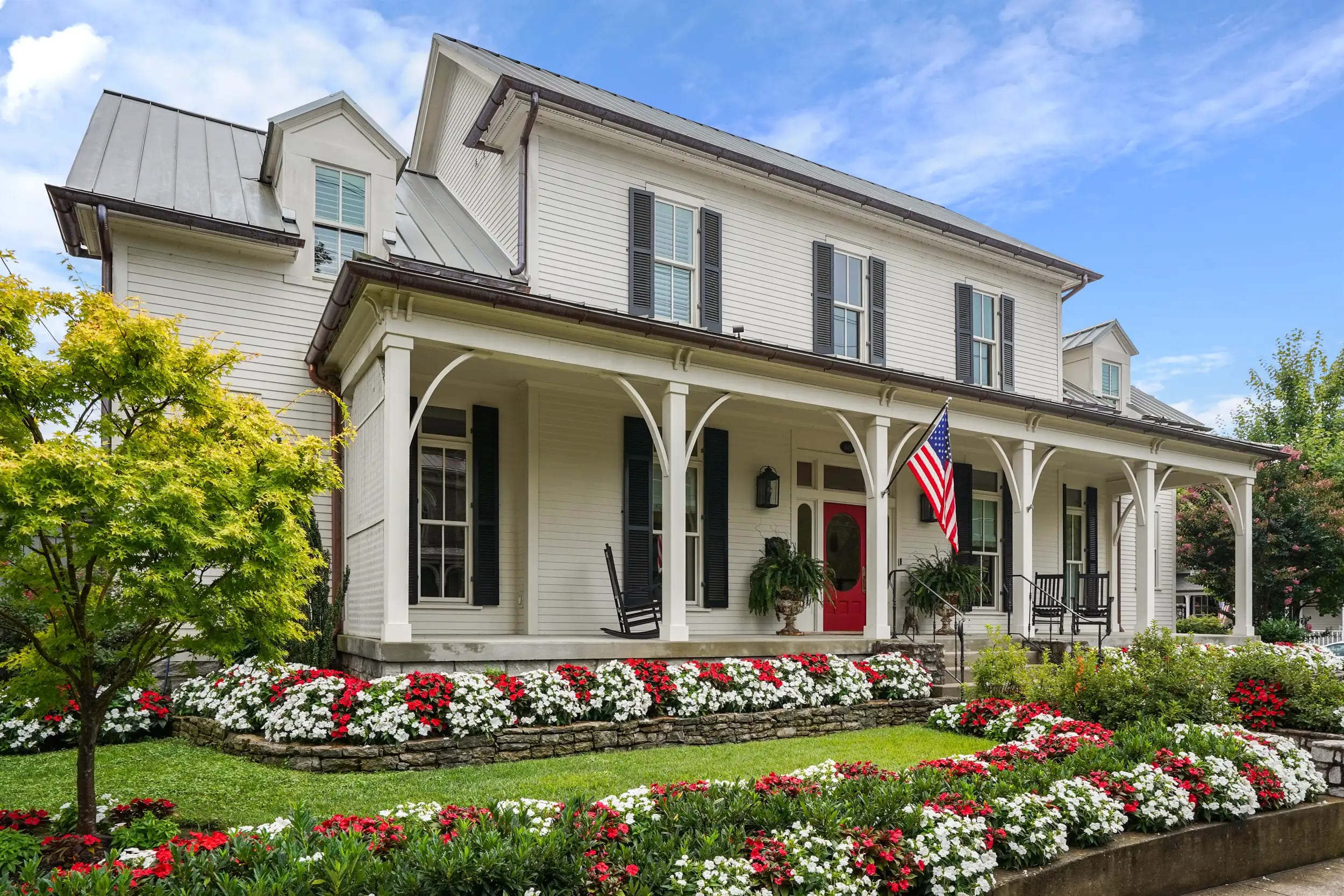
Franklin: Historic Form and Contemporary Growth
Franklin is shaped by continuity. Located south of Nashville in Williamson County, the city developed around a preserved historic core while accommodating steady residential expansion beyond it. The result is a place where architectural history and modern growth coexist without collapsing into nostalgia or sprawl.
Unlike communities built primarily through recent development, Franklin’s identity remains anchored by its original town plan. The downtown square, surrounding neighborhoods, and historic corridors continue to influence how the city functions and how new areas evolve.
Architectural Character and Housing Stock
Franklin’s residential architecture spans a wide range of eras. Near downtown, historic homes and early residential streets reflect traditional proportions, walkability, and a close relationship between buildings and public space. These areas emphasize scale, detail, and continuity.
Beyond the historic core, newer neighborhoods introduce larger homes and planned communities, often designed around landscape, privacy, and long-term living. While architectural styles vary, the strongest examples respect site conditions and maintain a sense of order rather than novelty.
This combination allows Franklin to accommodate growth while preserving a clear architectural lineage.
Walkability and Neighborhood Structure
Downtown Franklin remains one of the region’s most walkable environments, defined by compact blocks, storefront continuity, and civic space. Daily life here unfolds at a pedestrian pace, supported by proximity rather than speed.
Outside the core, neighborhoods are more dispersed, with daily movement oriented around driving rather than walking. This contrast creates distinct living patterns within the same city, allowing residents to choose between proximity and space based on preference.
Living in Franklin
Franklin attracts buyers seeking balance. Its setting supports family life, long-term residency, and a sense of rootedness, while still offering access to regional employment and cultural centers.
Homes here are often chosen for their longevity rather than trend alignment. Buyers tend to value neighborhoods that feel stable, legible, and thoughtfully planned.
Buyers drawn to Franklin often also consider Brentwood, Leiper’s Fork, and College Grove, depending on whether they prioritize proximity, acreage, or long-term community roots.
Real Estate Perspective
From a real estate standpoint, Franklin benefits from fundamentals that endure. Strong schools, established neighborhoods, and controlled growth contribute to consistent demand.
Properties that respect architectural context and site planning tend to perform best over time. Whether buying or selling, understanding how Franklin’s historic core and newer development patterns interact is key to making informed decisions.
Franklin’s strength lies not in reinvention, but in continuity.
Buyers focused on architectural integrity and long-term livability often track opportunities in this neighborhood through Jake’s List, a curated collection of design-forward homes informed by architectural context rather than surface features. This is a more streamlined approach than doing vague internet searches like "Franklin TN real estate" or "houses for sale in Franklin TN" or "Franklin TN houses for sale" which won't yield the depth most serious buyers are looking for.
Frequently Asked Questions
How does living in downtown Franklin differ from living in newer parts of the city?
Downtown Franklin is organized around walkability, historic streets, and proximity to shops and civic spaces. Newer areas prioritize space, privacy, and driving access, creating two very different daily living experiences within the same city.
Does Franklin still feel connected as it continues to grow?
Yes. Franklin’s growth has largely expanded outward from a strong historic core, which helps maintain a sense of continuity even as new neighborhoods are added. This structure keeps the city legible rather than fragmented.
Who is Franklin best suited for long-term living?
Franklin appeals to buyers who value stability, family-oriented neighborhoods, and a clear sense of place. It tends to attract people looking to settle for the long term rather than those seeking short-term lifestyle flexibility.